
Debate 4: Corporate Practices
23 سبتمبر، 2026 2026-09-09 11:35Debate 4: Corporate Practices
Debate Question: “Should companies promote internally rather than hire externally for executive roles?”
Introduction:
Corporate leadership strategies have evolved dramatically over the past few decades. Historically, major firms relied heavily on predictable, lifelong career ladders in which executives progressed from entry-level positions to the C-suite. However, with rapid technological disruption and globalization, many organizations now look to external recruitment to fill critical executive roles. This shift has sparked an intense corporate debate: Should companies prioritize promoting from within, or look outside to secure top leadership talent? Let’s explore both sides of the debate.
Arguments FOR the Motion:
1. Retention of Institutional Knowledge and Operational Continuity
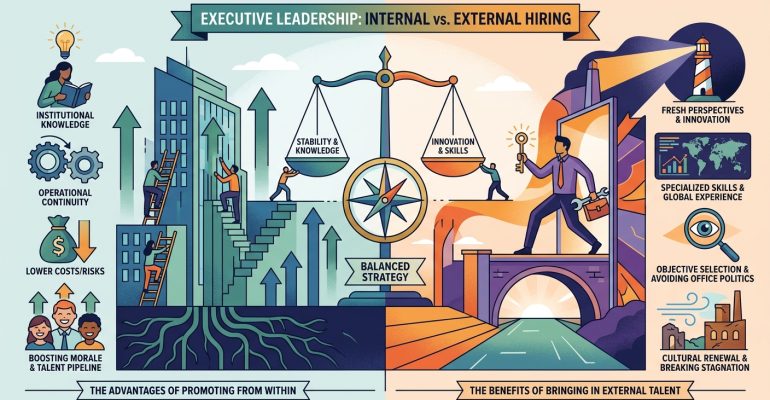
When a company fills an executive vacancy from within, it retains an invaluable asset: deep institutional knowledge. Internal candidates already possess a comprehensive understanding of the firm’s core operational workflows, long-term strategic history, and systemic challenges. They do not need to spend their critical first months learning the basic mechanics of how the business operates, allowing for a smoother transition of power.
This continuity heavily impacts organizational stability. Research within human resource frameworks indicates that internal promotions drastically reduce executive onboarding times and minimize operational disruption. Leaders who rise through the ranks are already deeply integrated into the existing corporate structure, ensuring that ongoing strategic initiatives are maintained rather than disrupted by a sudden change in management style.
A clear example of this can be found in long-standing corporate successions, where internal leaders can smoothly execute multi-year strategies without causing organizational whiplash. Because these individuals already understand the company’s internal political dynamics and structural capabilities, they can make informed, data-driven decisions from day one.
In short, internal promotions safeguard an organization’s foundations, ensuring that decades of accumulated corporate wisdom remain inside the company.
2. Lower Financial Costs and Predictable Performance Risks
Another central advantage of promoting from within is that it is highly cost-effective and carries significantly lower performance risks compared to external recruitment. Initiating an external executive search is an incredibly expensive endeavour, routinely involving substantial executive search firm fees, sign-on bonuses, and inflated market-rate base salaries designed to lure talent away from competitors.
Furthermore, external executive hires carry a statistically higher risk of failure due to the “outsider premium” and potential culture shock. Financial and management analysts have frequently highlighted that internal promotions drastically reduce these upfront recruitment expenses and minimize the costly threat of early executive turnover, making internal progression a much safer financial investment for the enterprise.
This predictability stems from the fact that an internal candidate has a visible, verifiable track record within the specific company. Executive boards possess years of data regarding an internal candidate’s work ethic, leadership style, and interpersonal relationships.
The problem with external hiring, therefore, is the inherent gamble on how a resume translates to reality. Because an internal candidate’s performance is already proven within the company’s unique ecosystem, boards face far fewer blind spots when elevating them to the C-suite.
3. Boosting Employee Morale and Strengthening the Talent Pipeline
Prioritizing internal promotion serves as a powerful psychological incentive across all tiers of an organization. When employees see their peers and managers successfully climbing the corporate ladder into executive roles, it signals a clear meritocracy. It demonstrates that the company actively values loyalty, hard work, and long-term dedication, which significantly improves overall workforce engagement.
Workforce mobility data consistently reinforces this connection. Companies with robust internal career paths often experience significantly lower voluntary turnover rates among their high-potential mid-level managers. When top-performing employees recognize that the path to executive leadership is open to them, they are far more likely to stay, reducing the risk of “talent drain” to competitors.
Conversely, a corporate culture that consistently bypasses internal staff for outside talent risks creating widespread resentment and disillusionment. Employees may begin to feel that their dedication is a dead end, leading to quiet quitting or an exodus of institutional talent.
By building a dependable internal talent pipeline, companies not only fill immediate executive vacancies but also cultivate a highly motivated and loyal workforce dedicated to the firm’s long-term future.
4. Absolute Alignment with Corporate Culture and Values
One of the most complex challenges an executive face is integrating into an established corporate culture. Internal candidates have spent years, sometimes decades, breathing the company’s values and embodying its corporate identity. They understand the unwritten rules of communication, behavioural expectations, and the core mission that drives the daily workforce.
Management studies consistently reveal that internally promoted executives frequently outperform external hires during their first two years, specifically because they do not have to struggle with cultural assimilation. They do not have to earn the basic trust of the existing staff or decipher the company’s internal social dynamics; they have already built that credibility over time.
When an outsider is brought into a highly specialized corporate culture, there is an immediate risk of cultural rejection. An external executive may attempt to impose alien methodologies or corporate philosophies that clash aggressively with established and successful norms, leading to widespread organizational resistance and reduced productivity.
Ultimately, promoting internally ensures that the leadership transition reinforces, rather than fractures, the cultural identity that made the company successful in the first place.
Arguments AGAINST the Motion:
1. Limited Innovation and Fresh Perspectives
A central argument against relying solely on internal promotions is the inherent restriction it places on innovation. While internal candidates are deeply familiar with company culture and existing processes, this familiarity can frequently breed dangerous “groupthink”. Internal leaders may be inclined to continue existing practices out of comfort or tradition rather than challenge them, severely limiting corporate innovation. External hires, by contrast, introduce entirely new ideas, disruptive strategies, and vital industry insights that can revitalize stagnant organizations.
This pattern is well-documented across modern corporate landscapes. Executive search firms consistently emphasize that relying exclusively on internal talent restricts an organization’s adaptability and competitiveness in rapidly changing markets. External leaders bring broader industry knowledge and innovative operational approaches that internal candidates may not have access to from inside their corporate environment.
A clear example of this often occurs during major market shifts, where insular companies fail to recognize disruptive trends because their leadership has been trained to see the market through a singular, historical lens. External executives are unburdened by “the way we’ve always done things,” allowing them to identify inefficiencies and pivot the company toward new growth vectors.
In short, while internal candidates preserve the status quo, external hires are often the necessary catalyst to stimulate innovation and disrupt stagnation.
2. Risk of Deepening Skill Gaps
Another critical issue is that internal employees may lack the specialized skills or global experience required to guide an executive role successfully, particularly in industries undergoing massive technological disruption or international expansion. When a business model undergoes a fundamental shift, the existing internal talent pool may simply not possess the modern competencies required to navigate the new landscape. External hires can immediately bridge these gaps with proven, specialized expertise.
Market analysts note that while internal promotions are excellent for ensuring loyalty, they do not always provide the necessary competencies required for highly complex leadership challenges. In these scenarios, looking beyond the company walls becomes essential for survival and growth.
For instance, a traditional retail company trying to transition into a digital-first e-commerce powerhouse will rarely find the necessary technological architecture or digital supply-chain expertise within its legacy internal management team. Forcing an internal promotion into such a specialized role risks setting the executive up for failure.
Therefore, the problem is that relying purely on development from within can leave a company structurally ill-equipped to face sophisticated, modern market challenges.
3. Vulnerability to Corporate Bias and Office Politics
The internal promotion process is rarely entirely objective and can sometimes be heavily influenced by favouritism, personal relationships, or entrenched office politics rather than raw merit. This introduces the severe risk of placing underqualified or politically savvy individuals into critical leadership positions, which can profoundly harm overall organizational performance. External hiring, by comparison, introduces a much more objective, standardized, and competitive selection process.
Human resource experts highlight that internal promotions can easily create resentment and division among remaining employees if the process is perceived as unfair or biased. External recruitment can bypass these internal political factions by providing a wider talent pool and a strictly merit-based, rigorous evaluation.
When an internal manager is promoted over equally qualified peers, it can fracture team dynamics, trigger internal rivalries, and lead to accusations of corporate cronyism. This infighting drains productivity and distracts the leadership team from external market threats.
Thus, bringing in an external leader provides a clean slate, free from the historical baggage, alliances, and internal biases.
4. Institutional and Cultural Stagnation
Relying exclusively on internal promotions strongly reinforces the existing company culture, which may actually be outdated, toxic, or intensely resistant to change. When an organization is suffering from systemic cultural issues, promoting from within simply elevates individuals who have been conditioned by that very environment. External executives, however, possess the objective distance needed to challenge entrenched norms and drive radical cultural transformation that aligns with modern business realities.
Research into corporate longevity shows that companies relying heavily on internal promotions can face a high risk of becoming insular and inflexible. Conversely, external hires bring a diverse set of cultural, organizational, and operational experiences that can foster corporate adaptability.
When a corporate culture becomes complacent or resistant to modern compliance and diversity standards, an internal promotion acts as an endorsement of that stagnation. An external leader has the authority and outsider perspective required to break down toxic silos, overhaul outdated hierarchies, and reset corporate accountability.
Ultimately, while internal promotions echo the existing culture, external recruitment provides the necessary cultural renewal required to survive in a dynamic global market.
Final Thoughts: The question of whether companies should promote internally or hire externally for executive roles cannot be answered in simple terms. It involves balancing organizational stability, financial risk, cultural preservation, and the urgent need for competitive innovation. Rather than placing full reliance on any single approach, the debate highlights the need for a balanced, dynamic strategy that leverages internal succession planning while remaining open to strategic external talent acquisition to navigate rapid global change.
This blog has been contributed by Marya Alhaddad, Shahd Alkooheji, Arwa Alofi and Yara Bin Thani.