


Debate 3: Technology
16 سبتمبر، 2026 2026-09-09 11:25Debate 3: Technology
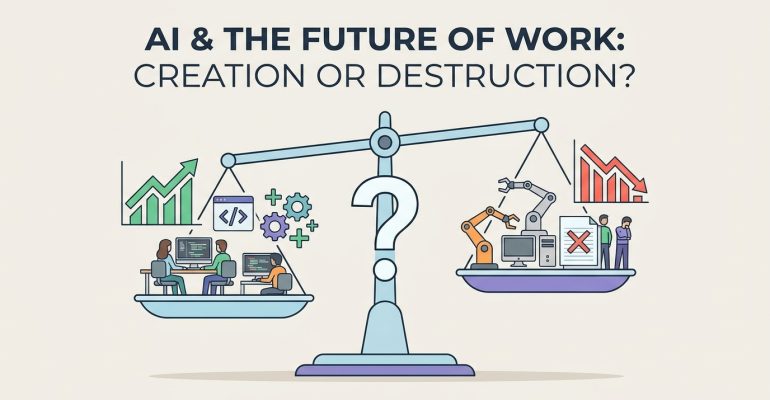
Debate Question: Will artificial intelligence create more jobs than it destroys?
Introduction:
Throughout history, every major technological leap has sparked deep societal anxiety about the future of work. From the Industrial Revolution to the rise of personal computers and the internet, the fear that machines would render human labour obsolete has been a recurring theme. Today, with the rapid deployment of Artificial Intelligence (AI), this debate has returned to the forefront of the global economy. The central question we face is critical: Will AI ultimately destroy more jobs than it creates, or will it act as a catalyst for unprecedented employment growth? Let’s explore both sides of the debate.
Arguments FOR the Motion:
1. Global Economic Data Points to a Clear Net Increase in Jobs
When evaluating the true impact of automation, major international studies consistently show that AI will create far more jobs than it replaces. Rather than relying on speculation, global economic forums rely on massive empirical data sets gathered from thousands of enterprises across dozens of distinct economies to forecast employment trends. The resulting data offers one of the strongest and most objective global assessments available regarding automation and the future workforce.
The figures emerging from these comprehensive studies are overwhelmingly positive. For instance, the World Economic Forum (WEF) predicts that by 2030, AI will create 170 million new jobs while displacing 92 million, leaving the global workforce with a massive net gain of 78 million jobs worldwide. This evidence directly refutes the common narrative that AI will cause widespread unemployment, proving instead that the technological shift can create significant new job opportunities.
A clear historical example of this trend can be seen in the rise of personal computing during the late 20th century. While early software automated routine tasks such as bookkeeping and typing, it simultaneously unlocked massive, unprecedented industries in software development, IT management, and digital services.
In short, when looking at concrete global evidence rather than fear-driven speculation, the data demonstrates that AI is structurally designed to be a powerful job creator.
2. Broad Industry Growth Drives Accelerated Corporate Hiring
Looking at current market realities rather than distant future projections reveals that industries heavily adopting AI are experiencing job growth, not decline. Employment rates are actively rising across almost every AI-exposed occupation, even within highly technical or analytical roles that were previously thought to be vulnerable to complete automation. This trend indicates a healthy and expanding job market driven directly by technological integration.
Data from PwC’s Global AI Jobs Barometer reinforces this phenomenon, showing that wages in AI-exposed sectors are rising twice as fast as in less AI-exposed fields. This wage growth occurs because AI dramatically boosts worker productivity and enhances corporate value creation. When companies implement AI, they don’t use it simply to downsize; they use it to scale their operations, expand their market share, and ultimately hire more people to handle their increased business volume.
This economic reality highlights a fundamental rule of business: efficient companies grow, and growing companies require more human talent to sustain their expansion. The financial gains realized through AI-driven productivity are consistently reinvested into corporate growth, resulting in higher recruitment rates and better-compensated roles across the board.
Therefore, the current evidence suggests that AI exposure acts as an economic multiplier, enabling companies to expand their headcount to keep pace with their accelerated growth.
3. The Emergence of Entirely New and Highly Specialized Job Categories
AI is not merely modifying existing career paths; it is actively creating entirely new occupational categories that were completely unimaginable just a few years ago. The rapid development and adoption of advanced AI agents like GPT-4o and Claude 3.5 have encouraged industries to create new roles dedicated strictly to the management, optimization, and oversight of these technologies.
A 2025 analysis of AI adoption identified the emergence of new professions, including AI prompt engineers, AI oversight specialists, AI workflow designers, and human-AI collaboration managers. Just as the rise of the internet created previously non-existent careers like web developers, mobile application designers, and social media managers, the AI revolution is rapidly establishing its own dedicated labour market.
These new roles require unique blended skills, combining technical understanding with human intuition, critical thinking, and linguistic precision. As AI systems become more integrated into daily business operations, the demand for professionals who can seamlessly bridge the gap between machine outputs and corporate goals will continue to grow.
Ultimately, AI follows a familiar historical pattern of previous technological breakthroughs. It closes old doors while opening entirely new ones, creating specialized fields of employment that did not previously exist.
4. Historical Precedent Shows Technology Consistently Upgrades and Multiplies Labor
To understand where the AI revolution is heading, we must look at how technology has interacted with human labour throughout modern history. Data from the U.S. Bureau of Labor Statistics explains that technological evolution is a gradual process that consistently leads to long-term employment growth, even within the specific occupations that are directly affected by the new tools.
Furthermore, international economic bodies like the OECD report that there is virtually no evidence of significant, widespread job losses in AI-exposed sectors. From the widespread adoption of electricity to the introduction of assembly lines, computers, and the internet, every major technological shift faced intense public backlash and predictions of economic ruin. Yet these innovations resulted in a larger, more prosperous global workforce.
This enduring economic pattern persists because automated efficiency lowers the cost of goods and services, which drives up consumer demand. Increased demand, in turn, forces industries to scale up production, creating a continuous cycle of economic renewal and job creation that absorbs displaced workers and elevates their standard of living.
In conclusion, history proves that innovation is fundamentally a job transformer rather than a job destroyer, and AI is steadily following this exact historical trajectory.
Arguments AGAINST the Motion:
1. The Unprecedented Speed and Scale of Disruption Left Displaced Workers Stranded
A major argument against the optimistic view of AI job creation is the unprecedented speed and massive scale at which this transformation is occurring. Unlike previous technological shifts, which unfolded gradually over generations and allowed the workforce ample time to naturally adapt and retrain, the AI revolution is moving at an exponential pace. This hyper-acceleration threatens to displace millions of workers simultaneously, leaving them with no viable path to immediate re-employment.
When administrative, customer service, or data entry roles are automated overnight by advanced AI systems, the displaced individuals cannot simply transition into positions such as “AI prompt engineers” or “machine learning researchers” within weeks. The specialized skills required for these newly created positions take years of intensive education and technical training to acquire.
As a result, a massive structural mismatch is created within the labour market. The jobs being destroyed are creating a group of workers whose skills no longer match the demands of the labour market, while the jobs being created are highly technical roles concentrated in elite sectors.
Therefore, the sheer velocity of AI adoption risks creating a permanent underclass of structurally unemployed workers who have been fundamentally outpaced by technology.
2. The Direct Elimination of Cognitive and Creative Knowledge Work
Historically, automation primarily targeted routine, manual, and repetitive blue-collar tasks, leaving white-collar knowledge workers largely insulated from technological unemployment. AI completely changes this dynamic by directly targeting cognitive, analytical, and creative professions. Large language models and generative AI systems can now write code, draft legal documents, analyse financial markets, generate marketing content, and create graphic designs within seconds.
This represents a fundamental shift in the nature of automation. By automating tasks that require high levels of education and critical thinking, AI threatens to transform the middle- and upper-class knowledge-based industries. Law firms, tech companies, and creative agencies can drastically reduce their junior-level headcount because a single senior professional paired with an advanced AI tool can now match the output of an entire team.
The problem, therefore, is that AI is disrupting the very sectors that historically absorbed workers displaced from manufacturing and agriculture.
By automating cognitive tasks, AI leaves fewer safe havens for human employment, threatening the foundational value of specialized higher education.
3. Corporate Cost-Cutting Measures and Downsizing Incentives
While optimistic forecasts suggest companies will use AI primarily to expand their operations, corporate reality dictates that the primary driver of technological adoption is often aggressive cost reduction. In highly competitive global markets, boards of directors face intense pressure to maximize shareholder value by reducing their largest recurring operational expenses: human labour and corporate benefits.
When an AI system can operate 24/7 without requiring a salary, healthcare, parental leave, or vacation time, the financial incentive for corporations to downsize their human staff becomes extremely strong. In many instances, the massive efficiency gains and profits generated by AI adoption are not reinvested into hiring more personnel, but are instead funnelled directly into stock buybacks, executive bonuses, and increased profit margins.
This corporate dynamic creates a stark imbalance where the economic benefits of AI are heavily concentrated at the top of the corporate hierarchy, while the average worker faces increased job insecurity and diminished bargaining power.
Thus, without strict regulatory intervention, the corporate deployment of AI will naturally favour labour reduction over job creation in a relentless pursuit of short-term profitability.
4. Widespread Wage Suppression and the “Gigification” of the Global Labor Market
Even in scenarios where AI does not completely eliminate jobs, it threatens to severely reduce the economic quality of the remaining positions. By automating a substantial portion of an employee’s daily responsibilities, AI lowers the level of expertise required for certain tasks, effectively de-skilling the profession. When a job requires less specialized human expertise due to AI assistance, corporate leverage increases, leading to widespread wage suppression.
Furthermore, AI-driven platforms accelerate the “gigification” of the labour market, breaking down stable, full-time employment into fractured, on-demand contract tasks. Workers are increasingly forced to compete globally on freelance digital platforms to train AI models, audit automated outputs, or perform micro-tasks for fractions of their historical pay, and while being stripped of job security and worker protections.
This transformation turns stable careers into precarious gig work, forcing human labour to act as low-paid “digital janitors” tasked with cleaning up, labelling, and verifying data for the very machines that displaced them.
Ultimately, the issue is not just the total quantity of jobs, but the systemic destruction of high-quality, high-paying careers in favour of a highly volatile, automated gig economy.
Final Thoughts:
The debate over whether AI will create more jobs than it destroys remains one of the most defining economic questions of our time. On one hand, global evidence and historical precedents strongly suggest that AI will act as a powerful engine for economic expansion, unlocking entirely new industries and elevating human productivity to historic heights.
On the other hand, the unprecedented speed, cognitive scope, and cost-cutting incentives of modern automation threaten to trigger massive structural unemployment and wage instability. Navigating this transition successfully will require ongoing global dialogue, corporate accountability, and adaptive educational pipelines to ensure the future of work creates better opportunities for society as a whole.
This blog has been contributed by Marya Alhaddad, Shahd Alkooheji, Arwa Alofi and Yara Bin Thani.