


Research Ethics at EUB
18/05/2026 2026-06-18 10:10Research Ethics at EUB
Research is closely connected to responsibility. As our academic community continues to grow, we place equal importance on how research is conducted as on the knowledge it produces. At its core, research is a scholarly responsibility that requires researchers to remain critically aware of their positionality and their role in the co-construction of knowledge. This involves ongoing reflective practice, through which researchers continually examine how their assumptions, values, and decisions shape each stage of the research process. Ethics, in this context, involves careful reflection on what is right and wrong within the specific settings and relationships in which research takes place.
Research ethics, therefore, are not a compliance exercise but a foundational commitment to developing new knowledge with integrity, respect, accountability, and care. Ethical reflection informs decision-making from research design and participant engagement through to data management and dissemination, ensuring that research is conducted in ways that minimise harm and sustain trust. EUB’s ethical review process is designed to actively support and encourage researchers to engage deeply with these considerations in a thoughtful and meaningful way. Understood in this way, ethical practice is inseparable from scholarly rigour, supporting research that is both methodologically robust and socially and intellectually meaningful.
The Values Driving Our Research
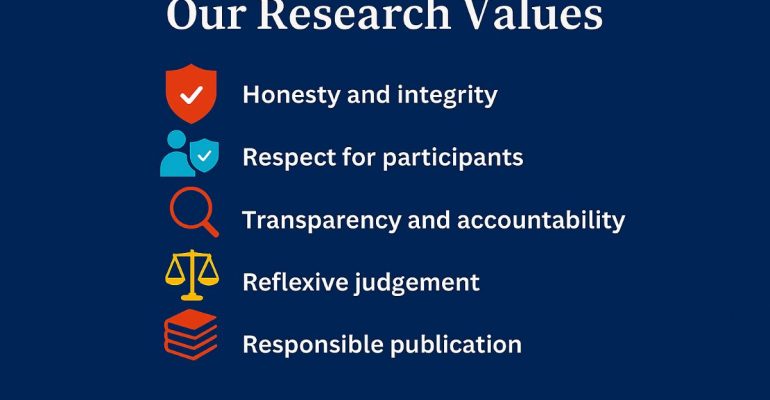
EUB’s approach to research ethics is grounded in a set of principles that are familiar across the academic world, but which we take care to apply in a practical and consistent way. Regardless of discipline or scale, we expect all researchers to uphold:
- Honesty and integrity – presenting findings truthfully and avoiding fabrication, falsification, or plagiarism
- Respect for participants – safeguarding dignity, ensuring informed consent, and protecting confidentiality
- Transparency and accountability – being open about methods and responsible for outcomes
- Reflexive judgement – making considered and critically informed decisions throughout the research process, while remaining aware of researcher positionality and its influence on interpretation
- Responsible publication – contributing meaningful, high-quality research with appropriate recognition of collaborators
A Structured and Supported Ethical Review Process
All research activities at EUB must undergo ethical review before any work begins.
Step 1: Ethics Form Submission. Researchers begin by completing the University’s online ethics form, a practical tool designed to support the early identification of potential ethical risks. This process embeds core principles of research ethics by encouraging researchers to take active responsibility for the integrity of their work. It promotes critical reflection on ethical considerations across the entire research lifecycle. By integrating ethical reasoning into all stages, the process enables researchers to anticipate and mitigate risks, safeguard participants, and uphold rigorous ethical standards.
Step 2: Risk Identification. The online ethics form requires researchers to outline the nature of their project or research activity, clearly stating its intended aims while reflecting any associated ethical concerns. This assesses whether the project involves high-risk elements, such as the inclusion of vulnerable human participants, the use of sensitive or identifiable data, or broader contextual and environmental risks. If no high-risk factors are identified, ethical approval is granted by the Director of Scientific Research and Innovation. Projects classified as high risk are referred to the Scientific Research and Development Committee for further ethical review.
Step 3: Committee Review. Projects classified as high risk are reviewed by the Scientific Research and Development Committee, a multidisciplinary body composed of EUB employees appointed for their specific areas of expertise. The committee ensures that proposals meet rigorous ethical standards and may request clarification, additional documentation, or clear evidence of how identified risks will be addressed before granting approval. Formal approval is issued only once the committee is satisfied.
The committee brings together diverse expertise to support a comprehensive and balanced review process. Members contribute perspectives across key areas, including participant welfare, legal and regulatory considerations, data management and AI-related risks, and sensitivity to the Bahraini cultural and institutional context. To ensure consistency, the committee uses a structured checklist, ensuring that core ethical issues are systematically examined across all projects, regardless of discipline. Importantly, identifying risks and ethical issues is only part of the process; researchers are expected to demonstrate how these will be appropriately addressed and taken into account.
Step 4: Approval. Research can only commence once formal ethical approval has been issued. This ensures that all projects begin on a foundation of careful consideration and responsibility.
Sustaining Ethical Review Practices
As EUB continues to expand its research activity, maintaining strong ethical standards remains a priority. It is about ensuring that research carried out under the University’s name contributes meaningfully to the body of knowledge with integrity, respect, accountability, and ethical engagement with the people and contexts it involves. For researchers, the message is straightforward: begin with the ethics form, consider potential risks carefully, and seek guidance early where needed. The ethical review process is designed to enable and strengthen good research, rather than to obstruct it.