

Debate 2: Culture and Language
09/09/2026 2026-09-09 11:14Debate 2: Culture and Language
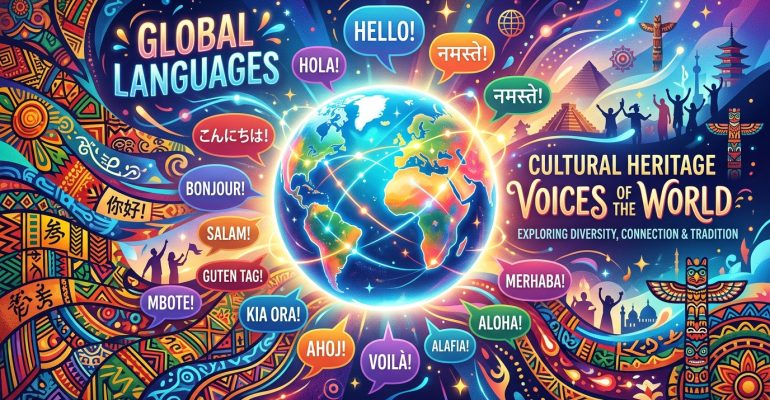
Debate Question: Does learning global languages erode cultural identity and heritage?
Introduction:
For centuries, one’s identity was closely tied by their voice and the unique dialect they spoke. Every language in the world evolved to hold and preserve the history, culture, and wisdom of its speakers. With the rise and rapid spread of globalisation, this process began to change. Learning different languages became a necessity to keep up and enhance communication with the rest of the world, shifting the uniqueness of communication to a standardised central language.
And thus, a question arose: can learning a global language erode centuries of culture and wisdom preserved through native languages, or can it help spread and preserve them? Let’s explore both sides of this question.
Arguments FOR the motion:
- Cultural Knowledge and Perceptions of the World are Tied to Vocabulary:
Language is not merely a tool for communication; it is a foundational phenomenon that has the power to shape how human beings think. According to linguistics research from Stanford University, the unique grammatical structures of a language can heavily dictate and influence how its speakers perceive the world, process information, and view reality. Stanford linguistics chair Dan Jurafsky has emphasised that studying the distinct differences in the world’s 7000 languages is vital, as each language uniquely reflects the background of those who speak it. This leads to the conclusion that the displacement of mother tongues by global languages can lead to a loss greater than that of communication – a loss of an irreplaceable cognitive lens, which in effect can erode the distinct cultural identities.
- The Spread of Global Languages Created a Decline in Native Language Fluency:
Research published in the Proceedings of the National Academy of Sciences (PNAS), which analysed the language skills of over 6000 secondary school students representing 400 distinct indigenous languages, revealed a rapid decline in native language fluency. Indigenous language fluency stood at 91% among the parents’ generation and plummeted to 58% among the youth. This research shows that when dominant languages take over education and social life, traditional language skills can decline rapidly, permanently depriving the younger generation from their cultural heritage.
- Global Languages Can Lead to Cultural Homogenisation
An analysis published by researcher Canny Aimie in Sociology and Criminology highlighted the mechanics of cultural homogenisation, a process where local traditions can be overshadowed by a dominant global culture. As English continues to dominate international business, higher education, and social media, platforms such as Instagram and Facebook have created a unified virtual space. in which youths worldwide consume similar media, lifestyles, and content. The analysis concludes that this linguistic and digital monopoly actively contributes to the erosion of cultural diversity, leaving individuals with a limited sense of local identity and belonging.
Arguments AGAINST the motion:
- Foreign Language Proficiency Enhances Intercultural Communication:
Learning global languages does not erase cultural identity but rather acts as a bridge for cross-cultural exchange. As globalisation has transformed the world into a global village, information now can be transmitted across nations with ease. According to research published in the International Journal of Intercultural Relations, proficiency in foreign languages directly improves cross-cultural understanding. The data proves that learning a global language encourages more positive attitudes towards people from different cultural backgrounds, allowing individuals to share their own heritage with the world while developing mutual respect.
- Multilingualism Can Improve Academic Performance and Employability:
Beyond cultural exchange, learning global languages can serve as a booster for personal and academic advancement. A study published in Springer Nature Link collected large data from Europe and concluded that learning global languages significantly reduces the likelihood of unemployment and boosts job prospects. Similarly, research published by MDPI confirms that language proficiency acts as a career enabler, expanding employment opportunities within international organisations. This advantage is also paired with academic benefits; research published by the American Council on the Teaching of Foreign Languages shows that studying a world language is linked to a higher achievement across all academic subjects and better performance on standardised tests. This is further supported by MDPI research from Kazakhstan, which found that students in multilingual academic settings develop stronger research and academic skills than those in monolingual settings.
- Learning Global Languages Provides the Essential Tools for Indigenous Language Revitalisation
The argument that global languages destroy native heritage overlooks the modern reality of cultural preservation, where global/dominant languages are used as a means to save endangered ones. Historically, when the Welsh language was declining, activists utilised English language media and political campaigns to secure language rights and spread awareness to a wider audience. Similarly, Maori communities and other indigenous groups have successfully used global communication networks to archive and revitalise their native tongues. This evidence demonstrates that global languages–instead of causing cultures to fade away–can provide minorities with the tools and visibility needed to protect and sustain their heritage in today’s world.
Final Thoughts:
The debate over global languages and cultural heritage reveals a rigorous tension between globalisation and local culture preservation. On one hand, academic data demonstrates that the rapid spread of global languages can reduce the local language fluency rate, erase unique cultural worldviews and cause homogenisation. On the other hand, research shows that proficiency in global languages can serve as a booster for academic achievement, better employment attributes, and intercultural understanding, while also providing a platform to revitalise endangered heritage.
The acquisition of a global language does not have to be a choice that requires the sacrifice of one’s roots. The challenge for modern societies lies not in combatting globalisation, but rather fostering multilingualism–embracing globalisation while investing in the protection and celebration of local native languages and cultures.
This blog has been contributed by Marya Alhaddad, Shahd Alkooheji, Arwa Alofi and Yara Bin Thani.