


Celebrating Research Engagement
11/06/2026 2026-09-02 15:31Celebrating Research Engagement
In today’s higher education landscape, research is increasingly shaped by the pressure to publish for metrics. Citation counts, journal rankings, and performance indicators, while not without value, can inadvertently shift attention away from what should remain at the heart of scholarly work: ethical integrity, intellectual excellence, and a genuine contribution to knowledge and society. As a result, the question facing institutions is not simply how to increase research output, but how to cultivate environments in which research remains purposeful, rigorous, and impactful.
Research does not develop in isolation; it is shaped by the conditions that enable it. Alongside individual expertise and intellectual curiosity, meaningful research is fostered through institutional structures, cultures, and sustained support. Maintaining engagement with research alongside ongoing teaching and student commitments requires deliberate and visible investment. Institutions therefore play a critical role in setting the tone, signalling that research is valued not only for how much is produced, but for how and why it is undertaken.
At EUB, this is something we have sought to establish early in our development as a university. As a relatively new institution, we are building our research culture alongside our teaching mission, which makes our commitment to supporting and recognising research activity especially significant. Our Scientific Research and Innovation Centre (SRIC) has played a key role in emphasising that engagement with research is not only about output, but about meaningful impact, holistic researcher development, and research ethics. Many of our faculty are keen to remain active in research despite the demands of teaching, and creating an environment in which this is valued and supported is an important step in shaping our research culture. This is why the SRIC has established two key initiatives: the Faculty Research Prize and the Research Excellence Awards.
The EUB Annual Faculty Research Prize
The Faculty Research Prize was established to recognise sustained and meaningful contributions to research at EUB. It celebrates faculty who demonstrate a strong commitment to advancing research through impactful engagement and scholarship, highlighting contributions that enrich academic life, foster collaboration, and support the continued development of a research culture.
The prize adopts a broad and inclusive view of research activity. Evaluation considers research outputs and dissemination, including publications and conference presentations appropriate to discipline and career stage, alongside active engagement in research culture through participation in seminars, workshops, and institutional research initiatives. It also recognises the importance of collaboration, international networking, and capacity-building, valuing those who support colleagues and students in developing research skills and engaging with scholarly work. Open to all full-time faculty, the prize aims to ensure broad recognition across the academic community, with recipients eligible only once within a three-year period to encourage wider participation.
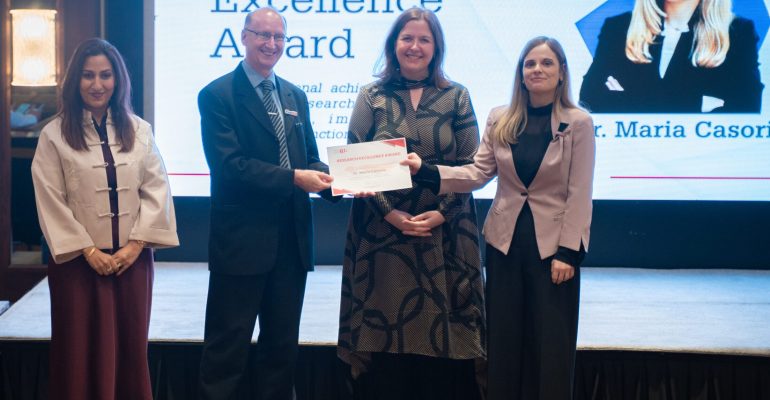
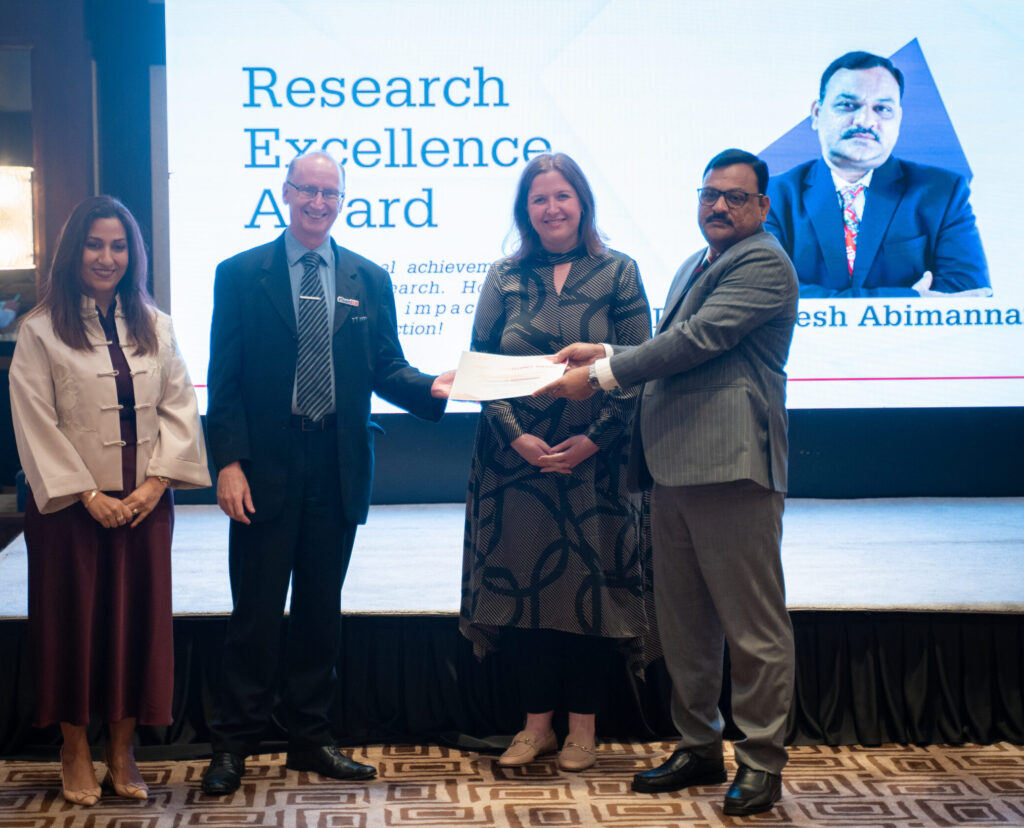
Faculty have contributed an impressive range of outputs and activities since the formation of the SRIC, reflecting both individual commitment and a shared effort to build and sustain EUB’s research culture. Following careful consideration, two colleagues were awarded the inaugural Faculty Research Prize in recognition of their outstanding contributions to research during the 2024–2025 academic year. We extend our sincere congratulations to Dr Maria Casoria and Dr Satheesh Abimannan.
- Dr Maria was recognised for her work in the field of law, including presentations at the World Lawyers Conference in Bahrain, a guest lecture at the University of Siena, and her role in moderating the Bahrain Business Law Forum. Through her publications, international collaborations, and efforts to bring distinguished speakers to EUB, she has strengthened both our research culture and the University’s visibility within the legal academic community.
- Dr Satheesh was also recognised for his significant contributions to computing research. His work includes multiple peer-reviewed journal articles, as well as a book and book chapters. His collaborations with researchers across the UK, China, Taiwan, and India, alongside active participation in conferences and research events, have contributed to the University’s growing international research profile.
EUB Research Excellence Awards
The introduction of the Research Excellence Awards at EUB reflects a clear strategic commitment to recognising and celebrating research excellence across disciplines. The awards are designed to encourage rigorous, high-quality scholarship that contributes meaningfully to academic and societal knowledge. They recognise peer-reviewed publications in established journals and by reputable publishers, signalling the value placed on intellectually robust and impactful research. By formally acknowledging these achievements, and providing a monetary award as a token of recognition, the initiative reinforces the importance of sustained scholarly contribution. In doing so, it supports the development of a more engaged, motivated, and research-active academic community.
We extend our congratulations to the recipients of the EUB Research Excellence Awards for 2024/25 and 2025/26:
- Dr Satheesh Abimannan for two published articles: one in Ecological Informatics, entitled “Marine ecological information prediction using adjacent location spatiotemporal deep learning models with ensemble learning techniques,” and one in Internet of Things, entitled “Distributed Edge-native Computing with Intelligence-Enabled Microservice Orchestration.”
- Mr Michael Mulligan for his book published by De Gruyter entitled “Shifting sovereignties: A global history of a concept in practice.“
- Dr Raza UL Mustafa for his article in Technologies entitled “MMTE: Micro-Moment Based Lightweight Trust Evaluation Model with Trust Spheres for Scalable Social Internet of Things.”
- Dr Salman Almutawa for two published articles: one in Discover Sustainability, entitled “Evaluating the spillover effects of FTSE4Good USA index: a sectoral analysis of United States international trade partners,” and one in the Journal of Risk and Financial Management, entitled “Stock market returns and crude oil price volatility: A comparative study between oil-exporting and oil-importing countries.”
- Dr Rémi Fuhrmann for his article publication in Journal of the History of International Law entitled “Localising civil wars: International law, the Spanish Civil War, and the institutionalisation of ‘non-intervention’.”
- Dr La’aleh Al-Aali, for her article in the International Journal of Aquatic Research and Environmental Studies, entitled “Green Management Practice and Environmental Performance: A Cross-Country Study of Corporate Sustainability Practice.”
These achievements represent important contributions to their respective fields. Their work not only advances knowledge within their disciplines but also contributes to the developing research identity of EUB as a whole. The importance of such recognition is reflected in anonymous faculty feedback collected as part of the SRIC annual faculty survey. One Research Excellence Award recipient noted that:
“It felt good to have my efforts recognised, and it made me feel more supported by the university. This has inspired me to stay active in publishing and contributing to research activities.”
This illustrates how recognition functions not simply as acknowledgement, but as a driver of sustained engagement and scholarly contribution.
Building a Research Culture at EUB
As EUB continues to develop, initiatives such as the Research Excellence Awards and the Faculty Research Prize form part of a broader effort to embed research within the academic life of the University. By recognising and celebrating achievement in its many forms, these initiatives help to create a diverse and thriving research environment. Additionally, by showcasing the research achievements of faculty and integrating current scholarship into the academic environment, students are exposed to new ideas, approaches, and ways of thinking. In this way, research recognition not only supports faculty, but contributes to the wider academic community.
Research excellence is not achieved solely through individual effort, but through the cultures and structures that support it. At this stage in our development, establishing clear mechanisms for recognition is an important step in signalling what we value as an institution. It reflects a shared understanding that meaningful, impactful research and diverse engagement with the research environment are central to our academic identity and future direction.